How Machine Learning for Personalization Actually Works: A Guide for Students
Ever feel like Spotify just gets you? Or how Netflix uncannily knows the perfect movie for your Friday night? That’s not a coincidence or some kind of digital magic.
It’s machine learning for personalization, and it’s the secret sauce that teaches a computer to understand what you love by spotting patterns in how you browse, click, and watch.
What Is AI Personalization Anyway?
Think of it like a digital sidekick that knows your vibe. This technology sifts through tons of data—your watch history, what you add to your cart, the articles you read—to figure out your unique tastes. The goal isn’t just to show you random stuff, but to actually predict what you’ll love next.
It’s about creating an experience so seamless it feels like it was built just for you. This tech is already woven into your daily life, often working so well you don’t even notice it. From your social media feed to the ads you see, it’s all powered by algorithms learning from your behavior.
Why This Matters More Than Ever
The demand for these custom-built experiences is absolutely exploding. This isn't just a trend anymore; by 2025, it's a non-negotiable for any business that wants to stay relevant.
A massive 92% of companies are already using AI-driven personalization to connect with their audience. This is backed by a huge jump in investment, with marketers now dedicating around 40% of their budgets to personalization—nearly double what they were spending just a couple of years ago. And people expect it, with 71% wanting personalized interactions from the brands they follow. You can learn more about how personalization is shaping modern business on Contentful.
The core idea is simple: instead of a one-size-fits-all approach, machine learning creates a one-size-for-one experience. It turns a generic app into your app.
Connecting the Dots with Online Data
So, how does this actually work at a basic level? The system analyzes how you interact with stuff online—whether that stuff is movies, songs, or in the case of our tool, BYTEY, food recommendations.
This creates what’s called a user-item matrix, which is basically a giant grid that maps out who liked what. The algorithm then uses this grid to find similarities between you and other people to fill in the gaps and suggest new things.
This visualization shows a simplified user-item matrix, which is the foundation of any good recommender system.
See those question marks? Those represent unknown ratings that the system is trying to predict. It’s essentially guessing what you might like based on your past actions and the behavior of people with similar tastes. This is the "why" behind the tech, making your digital life feel intuitive and perfectly custom-fit.
How Personalization Engines Actually Work
Ready to pop the hood? Let's break down how personalization engines turn all those clicks and views into spot-on recommendations. You don’t need a data science degree to get this—it’s really just about spotting patterns, but on a massive scale.
At its core, machine learning for personalization is all about teaching a system to predict what you'll like next. It gets there by analyzing your digital footprint and comparing it to millions of others, transforming raw data into an experience that feels like it was made just for you.
This infographic simplifies that flow, from gathering your data to delivering a personalized result.
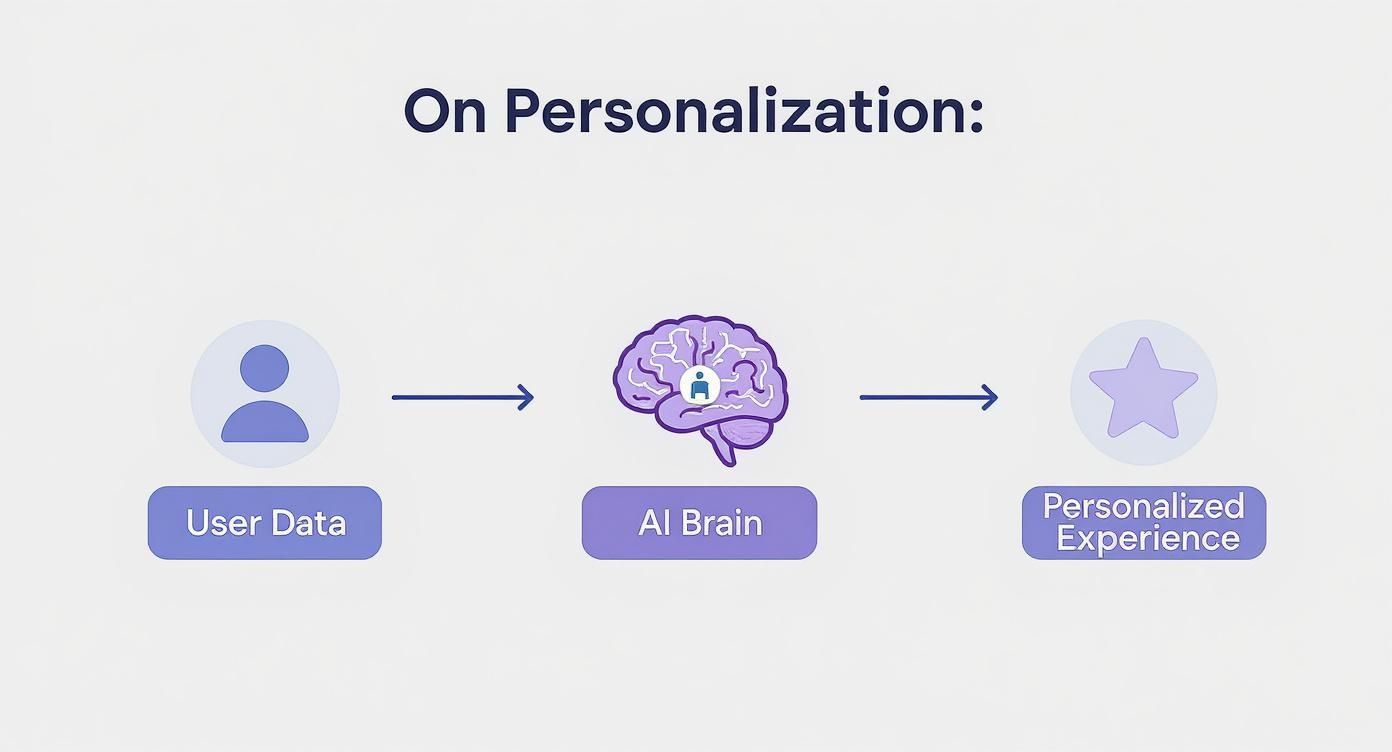
As you can see, it's a pretty straightforward cycle: your actions create data, the AI model learns from it, and the output is an experience that feels like it was designed by a friend who knows you perfectly.
The Three Main Flavors of Personalization
Not all recommendation engines work the same way. Most modern systems use one of three main approaches, each with its own strengths. Think of them as different strategies for picking the perfect movie for a friend on a Friday night.
Three Core Personalization Methods Explained
Here's a simplified look at the main machine learning approaches that power the recommendations you see every day.
Method | How It Works (Analogy) | Best For... | Example |
|---|---|---|---|
Collaborative Filtering | Like a friend saying, "People with your taste in music also love this new band." | Finding new items based on community behavior. | Amazon's "Customers who bought this also bought..." |
Content-Based Filtering | Like a streaming service suggesting another sci-fi movie because you just watched three in a row. | Deepening engagement with familiar types of content. | YouTube suggesting videos similar to what you just watched. |
Hybrid Models | The friend who knows you love indie rock and sees that people with similar taste just discovered a new band. | Delivering highly accurate, diverse, and surprising recommendations. | Netflix and Spotify's recommendation feeds. |
Each method has its place, but the real magic happens when you start blending them together.
1. Collaborative Filtering: The "People Like You" Method
This is the most common approach, and it works a lot like getting a word-of-mouth recommendation. It doesn't need to know anything about the products themselves—only who liked what.
Imagine you and a friend both love indie bands A, B, and C. If your friend discovers a new band, D, the system will probably recommend band D to you next, assuming your tastes will continue to line up. It’s all about finding users with a similar "taste profile" and sharing discoveries between them.
2. Content-Based Filtering: The "More of What You Love" Method
This method zeroes in on the items themselves. It analyzes the attributes—like genre, ingredients, or keywords—of things you’ve liked in the past to recommend more of the same.
If you spend your weekend binge-watching sci-fi shows set in space, a content-based filter will look for other shows with the tags "sci-fi" and "space." It’s a simple but effective way to find more of what you already know you enjoy.
3. Hybrid Models: The Best of Both Worlds
Why choose one when you can have both? Hybrid models combine the strengths of collaborative and content-based filtering to deliver the most accurate—and surprisingly delightful—recommendations.
This mix prevents you from getting stuck in a recommendation bubble while still serving up things you're almost guaranteed to love.
Bringing It All Together with BYTEY
So, how does a tool like BYTEY put these concepts into action? Our platform uses a sophisticated hybrid model to learn your unique food preferences from the moment you sign up.
BYTEY starts building your profile based on every interaction. Here's a quick look at the data it uses:
Explicit Data: This is stuff you tell us directly, like the "Taste Tags" you select (think , , or ), cuisines you favorite, and restaurants you rate highly.
Implicit Data: This is your behavior—the dishes you click on, how long you look at a menu, and what you ultimately end up ordering.
BYTEY’s algorithm then combines this information. It uses collaborative filtering to find your "food twins"—other users whose ordering habits are a lot like yours—to suggest restaurants they love that you haven't tried yet.
At the same time, its content-based filtering analyzes the dishes themselves. If you consistently order spicy Thai food, it will prioritize other restaurants known for their fiery curries and noodle dishes. This dual approach ensures your recommendations aren't just relevant but also help you discover new local gems you'll genuinely love.
Gathering and Using Data the Smart Way
A powerful machine learning model is like a top chef—it needs incredible ingredients to create something amazing. In the world of personalization, that magic ingredient is data. The quality of your recommendations is directly tied to the quality of the data you feed the system.
So, where does this information come from, and how do you use it effectively without being creepy?
Let's dive into the two main types of data that fuel a personalization engine. Think of it as the difference between someone telling you what they like versus you figuring it out by observing their actions.

Explicit Data: What Your Users Tell You
Explicit data is information users give you on purpose. It’s clear, straightforward, and leaves very little room for guesswork. When you leave a five-star rating, choose your favorite genres on a streaming service, or fill out a survey, you're handing over explicit data.
Star Ratings and Reviews: This is the classic example. A 1-star or 5-star rating is a direct signal of preference. Writing a detailed review is even better, offering rich, qualitative feedback. For instance, a great restaurant review provides specific details about dishes and ambiance, which is invaluable data.
User Preferences: Think about when you first sign up for an app like BYTEY and select "Taste Tags" like , , or . You are explicitly telling the system what you want to see.
Surveys and Feedback Forms: Directly asking users what they think is a goldmine for understanding their needs and improving their experience.
This type of data is powerful because it’s unambiguous. The catch? Not everyone takes the time to provide it. That's why you also need to look at what users do, not just what they say. If you're looking for inspiration, we have a guide on how to write restaurant reviews that don’t suck that highlights the kind of explicit feedback that helps everyone.
Implicit Data: The Digital Breadcrumbs
Implicit data is all about observing a user’s behavior. It’s the trail of digital breadcrumbs they leave behind as they interact with your app or website. This data is collected in the background and is often way more plentiful than explicit feedback.
Common types of implicit data include:
Clickstream Data: Tracking which pages a user visits, in what order, and what they click on.
Watch/Listen Time: How long someone watches a video or listens to a song is a strong indicator of interest.
Purchase History: The ultimate signal—what someone actually spends money on.
Search Queries: What users type into a search bar reveals their immediate intent.
The challenge with implicit data is that it requires interpretation. A click doesn’t always equal genuine interest, but over thousands of interactions, powerful patterns start to emerge. This is where machine learning for personalization truly shines, sifting through these subtle signals to build a rich, dynamic user profile.
The Non-Negotiable Rule: Building Trust Through Ethics
Now for the most important part. Collecting data comes with a huge responsibility. In a world where data breaches and privacy scandals are common, being transparent and ethical isn't just good practice—it's essential for survival.
Building a great personalization experience is fundamentally about trust. Users will only share their data if they believe you'll use it responsibly to make their lives better, not to exploit them.
This means putting user privacy at the center of everything you do. Here’s the playbook:
Be Radically Transparent: Clearly explain what data you're collecting and exactly how you're using it to improve their experience. No confusing legal jargon.
Get Explicit Consent: Don't hide data collection in the fine print. Give users clear, easy-to-understand choices about their data.
Provide Control: Make it simple for users to view, manage, and delete their data whenever they want.
Tools like BYTEY are designed with a "privacy-first" approach. By integrating with online data sources, the platform builds helpful user profiles while ensuring all data is handled securely and with user consent. This responsible approach is the only way to build a loyal community that sticks around.
Building Your First Personalization Project
Alright, enough theory. Let's get our hands dirty and actually build something. This is your roadmap for creating a simple personalization model from scratch, designed for students or anyone just curious enough to try. We're going to break down the process and make it feel less like rocket science and more like a weekend project.
The goal here isn't to build the next Netflix algorithm overnight. Think smaller. We're mapping out something manageable, like a recommendation engine for a personal blog or a small online store. Consider it the "Hello, World!" of personalization—a project that gives you a tangible win and a solid foundation to build on.
Step 1: Define Your Goal
Before you write a single line of code, you have to know what you're trying to achieve. What does "success" actually look like? Be specific. A clear goal is your north star, guiding every decision you make, from the data you collect to the algorithm you choose.
For a first project, keep it simple and focused. Here are a few ideas:
For a Blog: "Recommend 3 other articles a reader might like based on the one they just finished."
For a Small Store: "Showcase a 'You Might Also Like' section with products similar to the one currently being viewed."
For a Movie Review Site: "Suggest 5 movies a user might enjoy based on their past ratings."
Your goal needs to be measurable. This is absolutely critical for later when you need to figure out if your model is actually doing its job.
Step 2: Find Your Data and Tools
Now for the two key ingredients: data and tools. Luckily, you don't need a massive, private dataset to get started. The internet is overflowing with free, high-quality public datasets that are perfect for learning.
Where to Find Datasets:
Kaggle: This is the go-to spot for data science competitions and public datasets on everything from movies to e-commerce.
UCI Machine Learning Repository: A classic collection of datasets that have been used in countless research papers. It's a goldmine for practice projects.
Beginner-Friendly Tools:
You'll be working mostly in Python, the lingua franca of data science. Don't sweat it if you're not an expert—these libraries do most of the heavy lifting for you.
Pandas: Your new best friend for loading, cleaning, and organizing data.
Scikit-learn: An amazing, all-in-one library that makes it incredibly simple to implement basic machine learning algorithms.
Getting comfortable with these tools is a huge step. They are the building blocks for nearly every data project you'll encounter, from a simple college assignment to a full-blown professional application.
This kind of practical experience is becoming incredibly valuable. The global machine learning market is booming, valued at over $93 billion worldwide in 2025 and projected to soar past $1.4 trillion by 2034. This growth is fueled by a massive demand for skills in building personalization systems. You can find more insights on the explosive growth of the machine learning market and its impact on Radixweb.
Step 3: Prepare Your Data and Choose an Algorithm
This is where the real work begins. Raw data is almost always messy, so you'll need to clean it up. That might mean removing duplicate entries, figuring out what to do with missing values, and getting your data into a simple user-item format—think of a grid showing which users have interacted with which products.
Next, you need to pick an algorithm. For a first project, start simple. A content-based filtering approach is often the easiest to get off the ground. You can use Scikit-learn to find similarities between items based on their attributes (like genres for movies or categories for blog posts) and recommend the ones that are most alike.
Step 4: Train, Test, and See What Happens
Finally, it’s time to train your model on the data you've prepared and see how it performs. This is the moment of truth. Don't get discouraged if your first attempt isn't perfect—it rarely is. The key is to measure your results against the goal you set in Step 1 and look for ways to improve.
Our own platform, BYTEY, uses a similar iterative loop. It analyzes user interactions with different foods to constantly refine its suggestions, just like you would for your project. You can see these principles in action by checking out our guide on how a college student can best order food with BYTEY.
Platforms like BYTEY also streamline this workflow by handling the complex backend processes, bridging the gap between coding from scratch and using a powerful tool to bring your personalization ideas to life.
The Real-World Impact of Smart Personalization
So, what's the big deal? Why should you—as a future creator, developer, or entrepreneur—actually care about machine learning for personalization? Because this isn't just cool tech; it's about connecting with people in a way that drives real, tangible results.
When an app or service feels like it genuinely gets you, it creates a powerful sense of loyalty. For businesses, this translates directly to the bottom line by boosting key metrics like user engagement, conversions, and long-term retention. It’s the difference between someone who visits once and someone who becomes a loyal fan.
From Big Brands to Your Own Projects
You can see this impact everywhere. Giants like Netflix and Starbucks aren’t just selling movies or coffee; they're selling an experience built around you. And this data-driven approach delivers measurable business outcomes.
Companies that get AI-driven personalization right see up to a 15% increase in conversion rates and a 20% boost in customer satisfaction. Netflix famously credits its recommendation engine for a massive 75% increase in customer retention, while Starbucks saw a 10% sales jump after rolling out AI for its personalized campaigns. You can find more insights on how AI is enhancing customer experiences at SuperAGI.
But you don’t need to be a massive corporation to make this work. The same principles apply to creators and small businesses. Imagine you run a food blog. Instead of showing every visitor the same "Top 10 Recipes," you could highlight vegan recipes for one user and quick 30-minute meals for another.
This is the core of smart personalization: making every individual feel seen and understood. It transforms a generic interaction into a meaningful one, building a foundation of trust and loyalty.
This shift from a one-size-fits-all model to a one-size-for-one experience is what turns passive followers into an active, dedicated community. It's about providing genuine value tailored to each person's unique interests and needs.
How BYTEY Makes This a Reality
This is exactly how a tool like BYTEY operates. It’s not just about finding food; it's about finding the right food for you. By learning your "Taste Tags" and analyzing your order history, BYTEY doesn't just show you a list of nearby restaurants. It curates a list of places you're almost guaranteed to love.
Here’s how that translates to a better experience for college students:
Smarter Discovery: Instead of endless scrolling, you get spot-on suggestions that match your specific cravings, whether you’re looking for a late-night study snack, a cheap lunch spot near campus, or the best vegetarian place in town.
Building Community: It connects you with other users who have similar tastes, creating a trusted network for discovering new local gems.
Saving Time and Money: The system does the heavy lifting, filtering for deals and highly-rated spots, turning the chore of deciding what to eat into a fun and effortless process.
This approach isn’t just about convenience. It’s about building a relationship where you trust the platform to deliver recommendations that consistently hit the mark. If you want to see how this works in practice, check out our guide on how to find restaurants that don’t disappoint.
Ultimately, this is the power of personalization: it turns a simple utility into an indispensable part of your daily life.
Exploring the Future of Hyper-Personalization
We've walked through the what, why, and how of building personalization systems. Now for the exciting part: where is machine learning for personalization actually going? The future isn't just about slightly better movie recommendations; it’s about creating digital experiences that literally adapt to you in real-time.
Welcome to the world of hyper-personalization. This is the next frontier, where systems react not just to what you've done in the past, but to your immediate context. Imagine an app that knows you’re on your college campus and suggests a quick lunch spot with a student discount, or a playlist that shifts its vibe based on the time of day.
This incredible level of detail comes from weaving in new layers of live data. Hyper-personalization models can factor in your current location, the local weather, or even the device you're using to craft an experience that feels perfectly timed and almost psychic in its relevance. For a platform like BYTEY, this could mean suggesting a cozy soup spot the moment it starts to rain.
Beyond Content to Full Experiences
But the evolution doesn't stop with just recommending things. The next wave of AI is set to personalize the entire user interface itself. Think about an app where the layout, buttons, and features dynamically rearrange themselves based on how you use it.
For Power Users: The interface might surface advanced features and shortcuts, getting straight to the point.
For Newcomers: It could offer more guidance, tutorials, and highlight core functions to ease them in.
This approach turns a static app into a living, breathing digital space that grows and adapts alongside you. It’s a huge shift from just showing the right content to creating the perfect environment for every single user.
Navigating the Ethical Tightrope
With all this amazing potential comes a massive responsibility. As we push the boundaries of what personalization can do, we have to get serious about the ethical challenges. There's a fine line between being helpful and being creepy, and crossing it is a surefire way to lose a user's trust for good.
The goal is to build technology that empowers and delights users, not that makes them feel monitored. Your skills will be crucial in shaping a future where personalization is a force for good.
This means a rock-solid commitment to fairness and ensuring algorithms don't create biased or exclusionary outcomes. It also means championing data privacy and giving users complete, transparent control over their information. The skills you're developing today will place you at the forefront of this conversation, helping build a digital world that is not only smarter but also more respectful and fair for everyone.
Got a Few Lingering Questions?
Let's be real, you probably have a couple of questions. And that's totally fine—you're not the only one. We've gathered some of the most common things students and aspiring developers ask about using machine learning for personalization.
Do I Need to Be a Math Genius to Learn This?
Not at all! While the math behind the algorithms can get pretty gnarly, modern tools and libraries like Scikit-learn do all the heavy lifting. A solid gut feeling for the concepts—like why collaborative filtering is different from content-based filtering—is way more valuable for getting your first cool project off the ground.
What's the Difference Between Personalization and Customization?
Great question, and it's a common point of confusion. Customization is you manually telling an app what you want, like switching to dark mode. Personalization is when the system learns from your behavior to automatically adapt the experience for you, without you lifting a finger.
Think of it this way: customization is you giving direct orders. Personalization is the app anticipating what you need before you even ask.
The real magic of personalization is when it feels like the app just gets you. It proactively surfaces content and recommendations that feel uniquely relevant, making your digital life easier and more enjoyable.
Can I Build a Personalization Engine for a Small Project?
Absolutely! You don't need a massive, Netflix-sized dataset to get started. You could build a simple recommendation engine for a personal blog, a movie review site, or a small e-commerce project using publicly available data. It's a fantastic way to learn the ropes and add a high-impact project to your portfolio.
How Do I Keep Recommendations From Feeling Creepy?
This is the big one. The line between "helpful" and "creepy" is all about transparency and value. Be upfront about what data you’re using and why. More importantly, make sure your recommendations genuinely help the user.
If you help someone discover a new artist they end up loving, that feels smart and helpful. If you just follow them around the internet with the same ad for a pair of shoes they already bought, that feels creepy. Always, always focus on making the user's experience better.
Ready to see smart, fun personalization in action? With BYTEY, we turn every food order into a rewarding experience tailored just for you. Discover your next favorite meal on byteyapp.com.